


Introduction
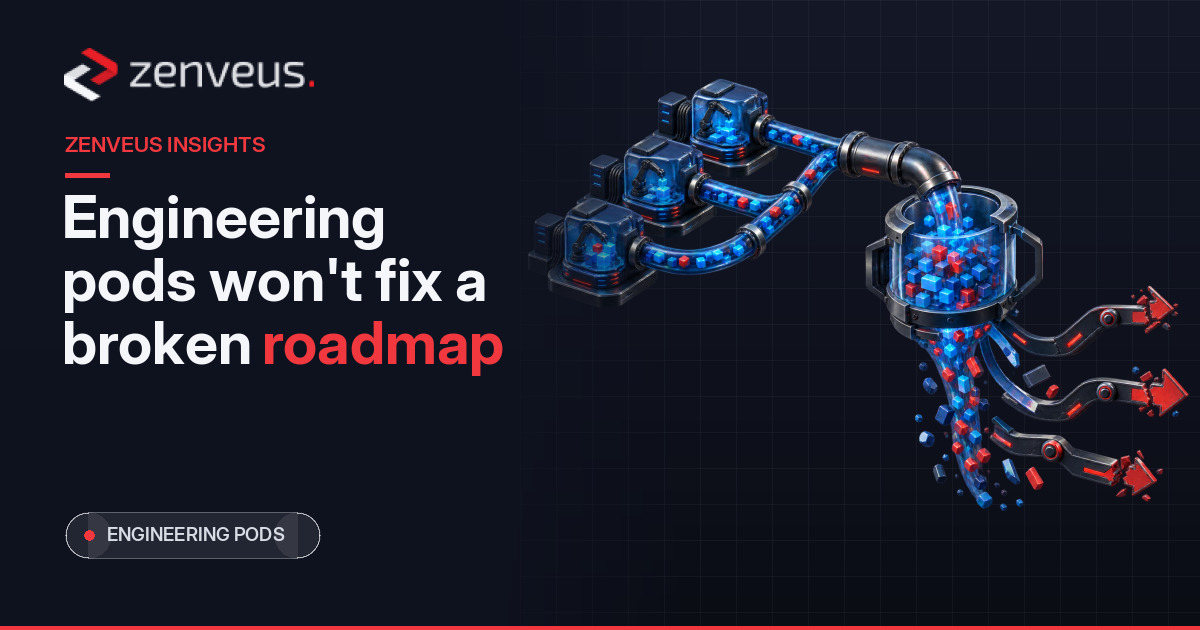
A founder signs a contract with an engineering pod because velocity looks broken. Sprints slip, features take longer than promised, and the instinct is to add capacity. Three months later the pod has shipped a stack of pull requests, closed a respectable number of tickets, and the product still doesn’t feel further along. The founder concludes the pod underperformed. Often the more accurate diagnosis is that the roadmap changed direction three times during the engagement, and the pod built exactly what it was told, repeatedly, for different destinations.
This is a decision problem, not a staffing problem. Adding engineers to an unclear roadmap does not clarify the roadmap. It multiplies the cost of every pivot, because now more people are rebuilding the same feature from a different angle. Sphere’s comparison of staff augmentation to delivery pods notes that delivery predictability comes from clearer ownership boundaries and fewer onboarding blockers, and ties that directly to improved roadmap accuracy. Read that the other way: if roadmap accuracy is already poor, a pod’s structural advantages have nothing to hold onto.
What you’ll learn
- What a pod actually fixes, and what it cannot touch
- The failure pattern: fast code, no compounding value
- The decision rule before you sign
- What to check before renewing or expanding a pod engagement
What a pod actually fixes, and what it cannot touch
A pod is a coordination solution. Borderlessmind’s research on staff augmentation identifies the core failure mode of adding isolated contractors: coordination overhead and fragmented accountability increase as headcount grows without shared context. A managed pod addresses this by keeping a team that has already shipped together, with one accountable unit instead of scattered individuals. That is a real problem and a real fix.
What a pod cannot fix is ambiguity about what to build next. If the founder or product lead changes priorities every few weeks based on the last customer call or a competitor’s launch, the pod will execute those changes faithfully and expensively. Pluralsight’s research on long-term roadmaps describes early-stage teams operating in reactive mode, where engineers work on whatever the loudest customer or the founder wants that week, with no roadmap or backlog anchoring the work. Hiring a pod into that environment does not install a roadmap. It installs more people executing the absence of one.
Related Zenveus resource: Fractional CTO insights.
The failure pattern: fast code, no compounding value
The specific symptom worth watching is not slow delivery. It is fast delivery that never compounds. A pod closes tickets on schedule, demos look fine, and the founder still cannot point to a feature set that survived two consecutive sprints without material rework. That symptom has at least three separate possible causes, and they require different evidence to distinguish.
The first cause is genuine pod underperformance: unclear technical ownership, poor code quality, or a mismatch between the pod’s skills and the stack. The second is roadmap churn originating from the founder or leadership team redirecting priorities before previous work stabilizes. The third is a discovery gap, where the product direction is uncertain because nobody has validated demand for the feature being built, so the roadmap is unstable for legitimate reasons rather than indecision.
Distinguishing these requires a specific check: pull the last six to eight weeks of the pod’s committed work against what actually shipped to users and stayed shipped. If the code is stable and unused, or repeatedly reworked at the direction of leadership rather than user feedback, the bottleneck sits above the pod. If the code itself breaks, or takes materially longer than scoped, the bottleneck may genuinely be technical execution. Conflating the two leads founders to either fire a capable pod or keep funding a pod that is executing the wrong plan with increasing efficiency.
Related Zenveus resource: Engineering Pods insights.
The decision rule before you sign
Before contracting a pod, apply one test: can you write down the next two quarters of priorities without them shifting based on internal opinion alone? If the roadmap only changes when new user evidence arrives, a pod is a reasonable fit. Walkingtree’s research on engineering staffing frames pods and staff augmentation as appropriate when timelines are fixed and the roadmap cannot wait for a slow hiring cycle, which presumes the roadmap itself is already stable enough to staff against.
If instead the roadmap changes because leadership keeps reprioritizing without new evidence, that is a leadership and prioritization gap, not a capacity gap. KORE1’s guidance on post-Series A scaling is blunt about the adjacent mistake: founders who set headcount targets based on what another startup announced on LinkedIn rather than what their actual roadmap demands end up in trouble. The same logic applies to pods. Hiring capacity to match an insecurity about velocity, rather than a validated backlog, produces the exact churn pattern that erases the pod’s output.
A useful reversible step before signing a multi-month pod contract is running a smaller, scoped engagement against a single, already-validated roadmap item, and measuring whether that item stays stable through delivery. If it does, scale the commitment. If leadership reopens the scope mid-build without new user evidence, that is the signal to fix prioritization before adding more delivery capacity. Tools like a hire vs pod calculator can help quantify the tradeoff once the roadmap question is settled, but it should not be used to substitute for that judgment.
What to check before renewing or expanding a pod engagement
If a pod is already engaged and output feels underwhelming, look for durable use of what shipped, not just shipped volume. Ask whether the cohort the feature targeted is still using it a month after launch, not whether it launched on schedule. A launch spike or an internal demo is not evidence that the feature earned its place on the roadmap. Sustained usage, support ticket reduction, or a retained metric are the evidence that would justify keeping the current scope or expanding it.
Sphere’s research on the shift from staff augmentation to delivery pods also flags a compliance and audit dimension worth checking in regulated contexts: pods with clear ownership boundaries produce more predictable audit outcomes and reduced remediation cycles, which matters directly for founders in fintech, insurance, or healthcare where roadmap churn compounds into compliance risk. If your team sits in one of those environments, a pod’s value depends even more on a stable roadmap, since rework in regulated systems carries higher remediation cost. If instead the evidence shows repeated rework driven by leadership indecision rather than user signal, the fix is a prioritization framework and a decision owner, not a bigger contract. A fractional CTO engagement or a structured technical diligence review can surface which pattern you are actually in before you renew.
NEXT STEP
Compare the real cost of hiring versus a pod
Model cost, speed, coverage, and management overhead for the delivery structure you are considering.
Use the Hire vs Pod Calculator