
Technology
The Age of the Single AI Model Is Over — Welcome to the Orchestration Era
The monoculture approach to AI is dying. As Anthropic pushes toward API-first billing, the future belongs to multi-model orchestration — and it changes everything.
The monoculture approach to AI is dying. As Anthropic pushes toward API-first billing, the future belongs to multi-model orchestration — and it changes everything.
For the past two years, the AI world operated on a simple premise: find the best model, use it for everything. GPT-4 comes out? Switch everything to GPT-4. Claude 3 Opus launches? Move everything to Opus. Gemini gets an upgrade? Test it, maybe switch.
This monoculture approach made sense when access was cheap and undifferentiated. But Anthropic just broke that model — literally and figuratively. By restricting third-party access and pushing toward direct API billing, they've made the "one model for everything" approach financially unsustainable for most users.
And honestly? Good. Because the monoculture approach was always inefficient. We were just too comfortable to notice.
On the surface, Anthropic's shift to API-first billing is a business decision. They need revenue. They can't subsidize unlimited access through third-party tools forever. Fair enough.
But zoom out and you see something bigger: the commoditization of AI inference. When every provider charges per token, models become interchangeable units of compute with different price-performance ratios. That's not a bug — it's the foundation of a new architecture.
We're entering the orchestration era, where the value isn't in any single model but in how you combine multiple models into intelligent workflows.
Think about an actual orchestra. You wouldn't have every musician play a Stradivarius violin. You need different instruments for different parts of the composition. The violins handle melody, the percussion handles rhythm, the brass handles power. And the conductor decides who plays when.
AI workflows are heading the same direction:
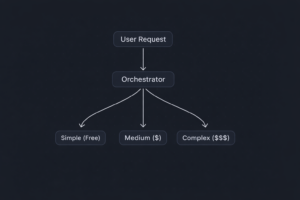
The conductor (orchestrator): A high-intelligence model like Claude Opus that understands the full picture, makes decisions, and coordinates.
First chair (specialized executor): Mid-tier models like Claude Sonnet or GPT-4o for substantive work.
Section players (bulk executors): Cheap models like Haiku or GPT-4o Mini for volume tasks.
Local ensemble (on-device models): Open-source models running locally for latency-sensitive or privacy-sensitive work.
The conductor doesn't play every note. It directs the performance.
As businesses increasingly rely on digital technologies, the risk of cyber threats also grows. A robust IT service provider will implement cutting-edge cybersecurity measures to safeguard your valuable data, sensitive information, and intellectual property. From firewall protection to regular vulnerability assessments, a comprehensive security strategy ensures that your business stays protected against cyberattacks.
The orchestrator pattern introduces fascinating engineering challenges:
Task decomposition: How do you break a complex request into subtasks that can be routed to different models? This is essentially a planning problem — and ironically, it's the kind of problem that large language models are great at solving.
Quality calibration: How do you know when a cheap model's output is "good enough"? You need evaluation criteria — either heuristic rules, a separate evaluator model, or human-in-the-loop checks.
Context management: Different models have different context windows, different strengths, different failure modes. The orchestrator needs to understand these and adapt.
Latency optimization: Running multiple models in sequence adds latency. Smart orchestration parallelizes where possible — send independent subtasks to different models simultaneously, then merge results.
Here's where it gets really interesting. The orchestrator can learn from its own routing decisions. Track which models succeed at which tasks. Build a feedback loop:
1. Orchestrator routes task to cheap model.
2. Output quality is evaluated (by the orchestrator, by heuristics, or by user feedback).
3. If quality is insufficient, re-route to a better model.
4. Log the decision for future routing.
Over time, your orchestration layer becomes a custom routing intelligence — it knows that Model A is great at Python but weak at Rust, that Model B handles long context well but struggles with math, that the local model is fine for autocomplete but needs cloud backup for anything over 200 tokens.
This is meta-learning at the systems level. You're not training a model; you're training a workflow.
If this pattern takes hold — and I believe it will — it changes the competitive dynamics of the AI industry:
No single model wins. The "GPT vs Claude vs Gemini" horse race becomes less relevant. What matters is how well models complement each other.
Open-source models become essential. Local models aren't trying to beat Opus. They're filling the "good enough for simple tasks" niche. That's a massive market, and it's where open-source thrives.
The value shifts to orchestration. If models are the instruments, the real value is in the conductor. Expect a wave of startups building orchestration layers, routing intelligence, and model management platforms.
Privacy gets easier. Sensitive data goes to local models. Only non-sensitive, complex tasks hit cloud APIs. This makes AI adoption viable for regulated industries.
Within the next 12 months, I expect: Major AI coding tools will add built-in multi-model routing. Open-source orchestration frameworks will mature rapidly. Anthropic and OpenAI will offer tiered API plans optimized for orchestration patterns. Local model quality will improve enough to handle 70%+ of routine tasks. "AI infrastructure engineer" will become a common job title.
In two years, using a single model for all AI tasks will seem as quaint as running your entire application on a single server. The future is distributed, multi-model, and orchestrated. And the developers who figure out orchestration first will have a massive edge.
Key Takeaways:
Start thinking about your AI usage as a system, not a tool. Map out which tasks need intelligence vs. which need speed vs. which need privacy. That map is the blueprint for your orchestration layer.
What is the AI orchestration era?
The AI orchestration era is the shift from using a single AI model for everything to combining multiple models into intelligent workflows. A smart orchestrator model (like Claude Opus) acts as the 'conductor,' delegating tasks to specialized models based on complexity, cost, and requirements — similar to how engineering teams delegate work.
Why is the single AI model approach dying?
Economics, not technology, is killing the single-model approach. As providers like Anthropic move to per-token billing, using expensive models for every task becomes financially unsustainable. Most tasks (50%+) are simple enough for cheap or local models, making the one-model-for-everything pattern wasteful.
What is meta-learning at the systems level in AI?
Meta-learning at the systems level means your orchestration layer gets smarter over time by tracking which models succeed at which tasks. Through a feedback loop of routing, evaluation, and logging, the system learns that certain models excel at specific languages, task types, or complexity levels — training a workflow rather than a model.
How does multi-model orchestration solve AI privacy concerns?
With orchestration, sensitive data stays on local models running on your own hardware, while only non-sensitive, complex tasks are sent to cloud APIs. This natural separation makes AI adoption viable for regulated industries like healthcare and finance that couldn't risk sending everything to external APIs.
Will GPT, Claude, and Gemini become interchangeable?
In an orchestration paradigm, individual model benchmarks matter less than how well models complement each other. Models become interchangeable units of compute with different price-performance ratios. The competitive advantage shifts from having the 'best' model to having the best orchestration layer that combines multiple models effectively.
What AI jobs will the orchestration era create?
Expect 'AI infrastructure engineer' to become a common job title within 12 months. There will be demand for engineers who specialize in building orchestration layers, routing intelligence, model management platforms, and cost-optimization systems. Startups building orchestration tooling will also emerge as a major category.



Field Experience
SAAS Founders Supported
Client Satisfaction
Faster Feature Delivery
Onboarding team

+ (92) 321 045 5502
contact@zenveus.com

4539 N 22nd St, Ste R, Phoenix, Maricopa County, Arizona, 85016
Office #2, 2-C St 1, DHA Phase 7 Ext., Karachi, Sindh, 75500